Home  |  About Robert Richter  |  Video/Filmography  |  Contact Us  |  Support  |  Site map

Documentaries On:

Leaving Home

Produced, directed and written by Robert Richter

Just released.

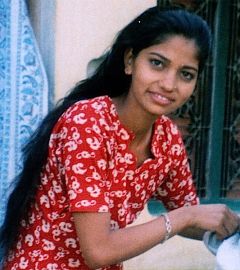
For Renu leaving home is different


Leaving home is what most of us do —
eventually. It's different for Renu. Can she fulfill her dreams of leaving her village home to become a teacher in the big city?

Most of India's 1.2 billion people live in villages. This documentary is about one of these villages—Rankhandi, 100 miles north of Delhi, with prime focus on Renu and her coming-of-age.


"Leaving Home" is about rural life, castes, marriage, weddings, family, motherhood, fatherhood—and change. And, as it develops, it is a film about women's rights.

As the film unfolds, many may be shocked by the restrictions on rights for teenage girls and women in the village. All of this is “normal”—and is documented in our new film—as we see Renu's coming of age in a way of life that many in other cultures consider to be one step up from slavery.

J. Michael Mahar, an American anthropologist, has been intermittently living in Rankhandi for over a half-century. Our guide and colorful and revealing story teller, he has seen the village move from the 18th to the 20th century before his eyes. He arranged our unusual access to those we filmed.

Nishu Varma, a journalist who is also our interpreter, talks with women with no men in hearing distance, and has revealing conversations never before in a film.

Jessie Epstein, Alan Jacobsen and Andrea Fantozzi did the filming along with Bob Richter. Amy Kessler is Editor, her first long form documentary.

Study Areas: anthropology, south Asia, India, women's rights, human rights, family, fatherhood, motherhood, castes, untouchables, weddings, adolescent behavior
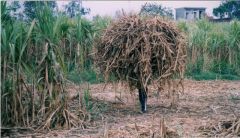
Harvesting sugar cane

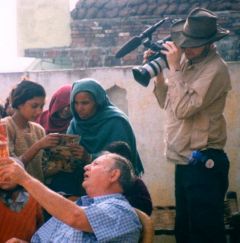
left to right: villager, translator/assoc.producer Nishu Varma  two villagers, Dr. Mahar
left to right: villager, translator/assoc.producer Nishu Varma two villagers, Dr. Mahar

exterior of family home

LEAVING HOME TRANSCRIPT
A Richter Productions Film
Nishu: If you have a chance to live in Delhi would you go?
Renu: Definitely. We'd definitely go and work together.
Nishu: Once you're out there's no problem?
Dimple: If we get the chance!
Renu: They might let us go together.

(title card on screen)
LEAVING HOME

(card on screen)
Most of India's 1.2 billion people
Live in rural villages

(card on screen)
Village of Rankhandi
100 miles north of Delhi

Mike: Hello. Who is that?
Krishan: When we find out Michael is coming, the entire family gets excited.
Mike: Who is that?
Son: That's you.
Mike: The anthropologist in action [Hindi] When I was a thin guy.
Krishan: Michael is like a father to me. He’s an important part of the family.
Mike: Who is this?
Renu: It's father.
Krishan: My son says I look crazy as a boy.
Suresh: You look just like him.
Krishan: My wife, daughter.
Woman: This is Anil, my daughter-in-law.
Mike: Okay. Little by little I pick up on and expand my vocabulary. Hello. Ram, ram. Nishu, what should I say to her? Blessings!
Nishu: Just touch her head.
Mike: But I always depend on my trusted crutch, Nishu Varma, multi-lingual, journalist by training, and an Italian citizen.

(card on screen)
No men were present when Nishu
and a woman cinematographer
spoke with women in the house.

Mamtesh: Are you wearing another shirt underneath?
Nishu: No. It’s the fashion. Do you wear jeans and t-shirts?
Mamtesh: No.
Nishu: Why do you wear the toe ring?
Mamtesh(Renu’s aunt): A married woman must always wear one. When the husband dies, we take it off and put it with him.
Nishu: There are certain nerves over here, which are connected to the uterus. When a girl gets married, this is the first thing that is put over here. And they just put it tightly, because after that when the lovemaking begins. So, initially it’s too much. It’s hyper-activity for the uterus. This is just to control.

(card on screen)
Mike initially was in a team of
Social Scientists helping
the Indian government plan
rural village development.

Mike: I keep coming back and tormenting these poor folks about every five or six years with endless questions. Nishu, let's say a few kind words to Mamaji here. Where did you get the glasses?
Mamaji: At the hospital in Muzaffarnagar.
Mike: Has the village changed since the old days?
Mamaji: How do I know? I'm practically blind!
Mike: What happens after a man dies?
Brahmin: If you eat chickens and goats, you will become a chicken or a goat in your next life.
Mike: So if you eat these meats, you will likely be born as whatever meat you eat.
(Mike, Nishu with old man)
Nishu: He was the one who taught you how to eat Indian food. You didn’t know that.
Mike: You were my master, my guru!
Old Man: That's right.
Mike: Namaste.

Mike: One way that you knew you were accepted, was the Brahma bulls that were tethered out there. If they didn't hook after you, you knew you were part of the family. The other measure is the dogs wouldn't come after you.
I first came in the fall of 1954, and I stayed here for two years. We photographed, interviewed, observed and recorded all facets that we could of village life.

(card on screen)
A film about the village was made
soon after Mike's arrival.

Old film narration: The village is a place where those who live in it find physical security. It is also a place where they find security of a different sort, especially the security which comes from following patterns of life, and believed to have persisted, essentially unchanged, for thousands of years.

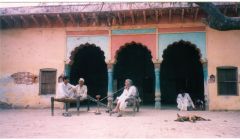
Mike: This is one of the oldest buildings in the village. It’s a men’s quarters, identical to what it was 50 years ago when men spent their time in the separate building called the chopar, the platform; one way of surveillance of strangers coming in and out of village. Here is the favorite occupation of older men, sharing the hookah, which they wouldn’t with anybody of any caste, either higher or lower.
Older man: People used to be much more conservative.
Nishu: The younger generation does not consider them at all.
Mike: It's the same in America. One of the 'old timers,' he used to drink a bottle of rum every day and eat opium, and he kept a Muslim dancing girl inside the men's quarters. The good old days!
When I returned in 1968, sitting with some of the old village men chit-chatting, I heard the school bell ring, and down the street came teenage girls, and I said, "How is it that a bunch of old curmudgeons such as you, would allow teenage girls to go to school?" And they kind of apologized, "So many of our sons are getting college educated, and they didn't want illiterate village girls as their wives, so we’re forced to send them to school.”
Older man: Western culture is coming in and ours is going out.
Mike: In the old days, very few men went to school, and an educated man was considered one who had completed the fourth grade.
Principal: Today, girls get very good grades. They score much higher than boys.

Upper School

Mike: There is no provision for any kind of social inter-action between single people of different genders, from puberty on. Everyone born in the village is considered brother and sister. So contact of any kind is considered incestuous.

(card on screen)
Girls and boys sit or stand
separately from each other
in the classroom.

Mike: When I was here a year or so ago, a boy and girl were found in the school cloakroom together. The other students locked the door, called the principal. The principal expelled them from the school. The next morning, I was told that the girl had killed herself by drinking rat poison the night before. And we strongly suspected that the girl didn’t necessarily kill herself. Her brothers may have helped her along, because of the dishonor to the family.
Nishu: What's forbidden for girls?
Mamtesh: A girl can't talk or laugh with a boy. She can't even laugh alone.

Renu's home

Nishu: What do girls do with their education?
Renu: Nothing. They stay home. Our parents don’t want us to study further, because they’ll have to look harder for a husband who has studied more than me. Boys usually don’t go past the 10th grade.
Tajmir. Renu's grandfather
Mike: Tajmir’s family is an 'extended family.' The adult married sons of a man and their wives and their children sharing a common residence, cooking from a common source of grain. You’ve got close to 20 people here, working as a single unit.
Krishan: It’s good they can work together. If they live separately the costs of living will double. We’ll need more cows, more fuel. When you live separately you don’t bond in the same way.
Mike: If you could have anything in the world, just one wish, what would you want the most?
Krishan: The best thing? That the family stays together and happy. We stay united.
Nishu: If you had one wish, what would you want?
Mamtesh: Most women would ask for happiness at home.
Nishu: It depends on the woman.
Mamtesh: No. Only girls would ask for something else. A woman asks for peace, food and money.

Renu: I’m study Sanskrit because I want to teach it.
Krishan: Renu can study here as long as she wants. So, there’s no worry about school but when it's her turn she must get married. Everything depends on the family she marries into.
Mother: Put this under him.
Renu with baby: I don’t need a blanket under him. If he pees, he pees.
Nishu: What can boys do that girls can’t?
Mamtesh: Boys can go anywhere. Girls can’t go alone.
Nishu: I wonder what they might be thinking of me?
Mamtesh: No. They know city girls move around.
Dimple: City women just move like that.
Nishu: Can girls ride outside?
Renu: No.
Krishan: Girls in the village don’t ride bikes. In the city maybe, but not here.
Nishu: Because it’s not accepted. It’s not the done thing that girls should go anywhere on the bike.
Krishan: Why would she need to ride a bike? The world outside is a bad place.
Nishu: Do the wives leave the house?
Bira: If there is a wedding to go to. Sometimes we go out to do a chore, but we don’t go out for no reason. Her husband doesn’t allow her to go out. You can leave after you're married a long time. Even now, if your husband says “No” you can’t go out.

Mike: Slippery! This mud! When I was here in the early '50s part of the transportation scene was a mucky track that went five miles into the railroad station and when the rains came the mud was 18 inches deep. It used to take a whole day to go to the nearby town of Deoband, walking both ways. Now you just hop on your motorcycle and you’re in town in ten minutes. Not only that, but the paved road enables students who can afford to, to go to school in town and live at home.
Krishan: We have schools, roads, electricity, telephone lines. We have everything we need.
Mike: When I came here if you wanted something done, was to do it with your own hands, or talk a bullock into doing it for you.
Dharampal: We had no infrastructure, very little water, no tube wells. Now we have all of these things.
Mike: The tube wells are a key ingredient in a farmer’s life, because he can go out, push a button any time day or night, and get all the water he wants. This is a tremendous innovation, probably the most important one in this area. New machines and new ways of doing agriculture. I wouldn't have predicted that 50 years ago.
Krishan: We grow sugar cane. That's been great for us.
Mike: In this village, land is owned by Rajputs, members of the warrior caste. These people have never been so prosperous in living memory, or historically. Reason for this is a sugar mill was built five miles from the village, and introduced cash into the economy for the first time. The government built all weather roads, reaching out from the sugar mill to all the major cane producing communities in the area. I saw them move from the 18th century to the 20th century before my very eyes. The impact of the wealth that has been generated, the level of prosperity of this community, has soared beyond anything I would have ever imagined.

Dharampal, Wealthy villager
Mike: How did you get rich?
Dharampal: I worked hard.
Man: He saved on labor costs.
Dharampal: I worked hard by myself, bought more land and production increased.
Nishu: Are you dizzy because you’re watching the wheel spin?
Mamtesh: No. We do this everyday.
Nishu: What will you do after making the thread?
Mamtesh: We will sell it, or exchange it for cloth.
Renu: I don’t like to do this work.
Dimple: It’s pointless.
Renu: I will never do this work in my entire life. However helpless I might be, I still won’t do this work!
Nishu: We’ll talk about it in ten years.

Mike: The world here is surrounded by cow dung. If we look down into the kitchen area, we'll find that the cow dung cake continues to reign supreme as the primary source of cooking fuel. Mike: And the odor, this is odorless. No odor at all. Although when it burns, it has a rather acrid smoke.
(Renu & Dimple make dung cakes)
Mike: Fresh cow dung is not considered to be dirty or filthy. People of any caste level feel free to collect cow dung, and make it into a cake. But it’s a lot of work. So usually they’ll use a woman of the sweeper caste to manufacture the cakes.

Mike: We’re now going to the Untouchable quarters, generally considered the lowest of the low. This is more or less the entrance to this section of the village. And this is dramatically different. The main houses are all fired brick. How did you afford a brick house?
Woman: Getting loans from the farmers.
Krishan: From the landlords.
Mike: You’re laborers?
Women: Yes.
Mike: Fifty years ago, fired brick was rare and a measure of high status, affordable only by the wealthy few.
(Untouchable home)
Mike: Is this your son?
Woman: This is my grandson.
Mike: this is her grandson.
Boy: My brother works as a laborer. Here in the village.
Mike [Hindi]: How much money do they earn a day?
Boy: 50 Rupees ($1.25)
Mike: When did you stop working?
Woman: Many years ago.
Mike: Does she sweep?
Woman: No.
Mike: She doesn't do that kind of work. Her family can make ends meet without her doing work outside the home. This all looks very modern. The quality of the wire which is better than the quality of the wire that's gone into in Krishan's house.
Mike: Who did the work?
Boy: The electrician.
Mike: Is he a government or private worker?
Boy: Private.
Mike: What caste is he from?
Boy: Untouchable.
Mike: The upshot of it is that, in this village the lower castes have shared in the prosperity. But it’s like what we find in many societies: “Them what has gets” and the upper caste get more than the lower caste.

(Sweeper girl)
Nishu: Where's your mother?
Girl: Working in that house.
Mike: There she is, collecting the sweeping from this household, including the ashes.
Mike: He’s going to go to the edge of the village and dump that on the compost heap.
Nishu: It‘s a she.
Mike: Oh, a she. The women do most of the cleaning work, but it doesn’t necessarily give them low self-esteem. They’re among the most outgoing and cheerful and assured women in the village. I attribute this to their independence. They are the breadwinners, a major contribution to the family income.
Sweeper woman: All we do is lift the cow dung and throw it! Woman: Take her to America! She works very hard. You’ve seen it!
Mike: I’ll give it some thought. [English] I'll think about it.
Mike: Let me introduce us to this lady. I remember meeting her in the old days. At that time, we took her picture carrying a big platter of cow dung on her head.
Woman: I’m still wearing the same thing. It’s the same as it was before; we work and we eat.

Mike: Where's the school?

(Private School)

Mike: Do you have any questions about America? Ask.
Girl: What god do you pray to in America?
Mike: Excellent!
Mike: How many students?
Bir Singh: 250.
Mike: In government schools you don’t have to pay tuition, but you do in the private schools, and the private schools are packed.
Bir Singh: I think everything has changed.

Bir Singh, School Principal
and Untouchable
Bir: My father knew what a man could do with education. I was the only son in the family, so he made sure I was educated.

(card on screen)
Most Untouchable men
are still field hands.

Mike: Sit down. Why don’t you get some chairs?
Bir: No, I’m all right. Our ancestors were always standing!
Mike: Once, Bir Singh’s father came by to see me. I invited him to sit down on the chair. He refused. So, I had a little straw hassock, and I said, “Well sit on there,” and he very reluctantly did so. And a Rajput saw him sitting on a hassock, rather than squatting on the floor, and he shouted in there, “Konto you son of a bitch, get down there on the floor where you belong. The American doesn’t know any better, but you do.”
Poona: In the old days, they forced us to work hard in their fields.
Krishan: A lot has changed. When I was born, lower castes did all the work. Kumars would make pots for religious activities. Now, you go to the market to buy anything ready-made. There are no more barbers, no more potters, no more washer men. We do our own work now. It's great, because we're self-reliant.

(SINGER WITH HARMONIUM)

Mike: What we have just experienced, sitting around in the untouchable quarters. In the old days, my hostess would ask me to bathe before I re-entered the home, the upper caste home where I was residing. I don’t think that’s an issue these days.

(card on screen)
Mike and Nishu are invited
to a Rajput neighbor's
wedding feast.

Mike: Is he from a Brahmin priest?
Man: Yes, he’s a Brahmin.
Mike: This is the priest who is doing the cooking. Because anybody of any caste can eat food cooked by a Brahmin. And so, one of the functions is for a priest not only to perform the wedding ceremony, but to cook the wedding feast. Now, he may not be the same one who does the ceremony but he's of the same family.
I remember one time at a feast an Untouchable put his hand against a basket full of freshly cooked rice like that, and the hostess had the whole thing thrown out.
Man: Would that happen today?
Mike: Let’s ask.
Nishu: If a low caste touched that rice, what would you do?
Man: We wouldn’t eat that.
Mike: But say he accidentally did it.
Nishu: He has refused it. He says it’s not possible.
Mike: Okay. He won't talk about it. So we know we’re dealing with a delicate subject.
Mike: They’re concerned with ritual pollution. That is fear of contamination by the touch of an Untouchable caste. So it’s not that you can’t touch an untouchable, it’s that you don’t want them to touch your food or water. I was talking to a fellow over here, when I was first trying to understand. And I was like, “Well, wait a minute. I understand from the neighbors that you have a Chomar mistress, a lower caste, untouchable woman.” “Oh yes.” “I heard she’s been your mistress for 30 years.” “Oh yes.” And I said, “What’s this untouchable business all about?” Never once in those 30 years have I ever accepted a glass of water from her hands.” And essentially, it’s what you take inside your body that’s the threat.
Man: Food is a pure thing for us.
Mike: So it's not that you can't touch an untouchable it's that you don't want them to touch you.

(card on screen)
As night falls, the Rajput
neighbor prepares for more
marriage festivities.

Mike: The marriage that’s about to take place, is a link that binds together the network of a caste group. And as long as they marry within their own group, there’s going to be a caste system.
One of the most sacred of Hindu symbols, the Lingam and Yoni, normally put in the innermost sanctum of a Hindu temple. Much of what we're looking at, is praying for or aspiring to fertility. And quite commonly, offerings are milk poured over the Lingham, that flows out through the opening in the Yoni. The Lingham and Yoni is a representation of the god Shiva.
Mamtesh: Shiva rituals are for unmarried girls. They ask Shiva for what they want.
Renu: Normally, people pray for a good husband.

Nishu: You saw your husband before the wedding?
Mamtesh: No.
Nishu: First time you saw him, what did you feel?
Mamtesh: I felt okay, nothing really.

(card on screen)
Women watch the groom's procession
and men's outdoor festivities.

Mike: In every generation half the people pack their suitcases and move out, and those are women. You must marry someone outside your own village. The wife goes to live with the husband's family.
Nishu: Would you like to see the person you get married to, before marriage?
Renu: Yes, I’d want to see the boy.
Nishu: Would you also want the chance to tell your parents what you think of him?
Renu: You don’t get such chances!

Suresh(Renu's mother: We hope our girls to marry into nice families.
Krishan: The way marriage happens is, a man takes a photograph of his son and shows it to everyone in a village.
Woman: Look at this guy! He's more handsome than the groom.
Nishu: No, the groom's cuter than everyone.
Mamtesh: This guy's much taller. The groom's nose is large.
Girl: So is his personality.
Krishan: If a girl's parents like the boy they talk about getting them together.
Suresh: I know that man.
Mamtesh: No. They are all strangers,

(Bollywood film on TV. Renu dancing)

Krishan: My biggest concern is Renu’s marriage. If I don’t give a dowry she can’t get married.

(card on screen)
Dowry is illegal in India
but has increased in rural weddings.
Nishu: Clothes, bedsheets, towels, doublebed, sofa set.
Mamtesh: Most families don't know what they'll get. Whatever the girl's family can give, they give on the day of the wedding. Suresh: If they don't like the dowry, they could make the girl miserable. If they want a motorcycle, they'll ask for it before the marriage.
Mike: Among the more wealthy ones, a common item in the dowry that the bride brings, is an automobile. There are dozens of them in the village.
Krishan: People say I have a lot of money, and the Americans can provide two cars for me. If I don't give enough, people might say I'm a miser. Dowry is a bad idea, but one person can’t change anything.
Nishu [to Dimple]: You’re second in line to get married?
Mamtesh: Actually she’s fourth in line.
Krishan: Dimple can’t get married until Renu gets married.
Dimple: I don't want to get married.
Renu: We're not thinking about it yet. We have older cousins who aren't married yet.
Nishu: So that means there’s a lot of time?
Renu & Dimple: Yes.
Nishu: What does Dimple think?
Dimple: About weddings? Your parents should arrange it.
Nishu: Why?
Dimple: If you get married to the person of their choice, if there are any problems in the marriage, you can always go to your parents. But if it’s a marriage to the person of your choice, you have no one to blame but yourself.

Mike: An Indian woman explained ot to me once, very nicely. She said, “You Americans look only at the blossoms. We like the blossoms. We look at the blossoms. But we go beyond that. We look at the strength of the branch, we look at the trunk of the tree and see how strong and sturdy it is, and then we look at the roots of the tree. And then we arrange the marriage.”
Nishu: That’s all right, but sometimes getting married of your own choice can also happen.
Dimple: No.
Chaman (Renu's uncle): Such thoughts do not exist in the village. The tradition in the village is whoever the parents decides is the person the girl marries.
Nishu: That is all right, but—
Chaman: Choice does not exist here.
Dimple: Uncle, please sit down (Chaman refuses)
Mike: The major threat to this whole scheme of things, to this whole society, is romantic love, if it allows individual choice in marriage.
Renu: [cautiously looking around) I think a girl should marry her own choice.
Mamtesh: You can't have false dreams. Your family won't let you do anything, so dreaming is a waste.
Dimple: But everyone must dream.

(Renu draws picture)
Nishu (to Women): What did you dream about, before you were married? Before you grew up? Everyone has such dreams.
Mamtesh: What is there to dream about? Everyone knows you have to get married. Then you get caught up in housework.
Nishu: Before all the house work, like where Dimple is in her life. Don't you have a dream to do something?
Dimple: Beauty parlor. First I’ll learn and then open my own.
Nishu: Is there one here?
Mamtesh: No.
Nishu: So you’ll have a huge market.

(card on screen)
Only men own and operate
shops in the village.
Krishan(calling down): We have everything but eggplant.
Dimple: One minute.
Mamtesh: The vegetable vendor.
(Dimple leaves) (Women cover their faces)
Nishu: Normally you cover your head at home, but you also cover your face?
Mamtesh: Yes. Suppose an older man is right there. We cover our heads completely.
Dimple: They do it for young men, too.
Nishu: Is this is a sign of respect, or something else?
Mamtesh: Respect. It’s considered respect for the elders.
Krishan: It’s just a bad habit. There’s no point. What matters is that your heart is pure.
Nishu: What if you decided one day not to cover your head?
Mamtesh: My husband would be very angry.
Nishu: Would he beat you?
Mamtesh: Yes.
Nishu: In this village, how many husbands beat up their wives?
Mamtesh: All husbands do that.
Nishu: All husbands?
Mamtesh: When they get angry they just beat up their wives. Why are you so surprised? Your husband never beat you?
Nishu: My husband? No, never.
Mamtesh: Here, everybody does that. (Laughter)

Nishu(to Krishan and brothers): If you tell your wife to do something and they don’t do it, what do you do?
Krishan: Why wouldn’t they do the work?
Nishu: What if they’re dangerous, like me?
Krishan: No, that’s not possible.
Suresh: He has a short temper. He’s a very bad person to be with at that time. He says ‘I’m going to kill myself and I’m going to kill you too’.
Sushil: There has never been a situation where she hasn’t done what I’ve said.
Nishu: But, what if the situation came. Would you beat her, scold her or what?
Sushil: No, I’ll try to explain it to her nicely, that’s the right thing to do.
Nishu: Chaman?
Chaman: I will try to explain to her nicely and she will understand.
Nishu: What if she doesn’t?
Chaman: She will.
Nishu: How is it possible that five saints were born in the same place? None of you fight with your wives?
Krishan: No.

Women: (laugh) They said that! If the work isn’t done their way, they hit us. They also love us.
Suresh (to camera): Jessie, you should get married here so that your husband can beat you too! (Laughter)

(card on screen)
The wedding festivities continue
throughout the night and for
several days.

(Fade in, new bride cooking)
Mike: Who gets up first in the morning?
Suresh: The new daughter-in-law. I wake up because I can hear her footsteps.
Mike: The new bride is the lowest rung on the ladder in the pecking order of the women’s quarters, and the mother-in-law is the top rung.
Nishu: Why is that?
Suresh: Because she’s younger. When I was younger I did most of the work.
(Old film, making chapatis)
Mamtesh: Our mother-in-law used to make thick chapatis. She didn’t know how to make the thin ones.
Mamtesh: As the daughter-in-laws keep coming in, they prepare better food and the house progresses.
Susresh: There’s a lot of love amongst us, so we don’t force the youngest one to do all the work. But the ultimate responsibility is hers.
(Mamtesh makes ghee for chapatis)
Suresh: In houses where there’s a lot of infighting, the work is assigned specifically to individuals. But in other houses this isn’t the case. Everyone helps out, sometimes you do more, sometimes less. Sometimes you don’t do any at all. This is how it is here in our house.
Son: Will it run Mother?
Mamtesh: Run it yourself.
Son: But will it run?
Nishu: Mamtesh, how did you feel when you first came here, after getting married?
Mamtesh: Everyone's a stranger, but you have to adjust.
Suresh: It feels strange at first, but then you start liking it. Now I never want to leave here.
Mamtesh: Yes, after some time you get used to it, and now I don’t feel like ever leaving this place.

(card on screen)
The Indian government provides
basic health care for the villagers.

(child getting inoculated)
Mike (to Nishu): All I want to know is, what kind of disease they were vaccinating for.
Mike(responding to old woman caressing Mike's face): Oh, she’s giving me her blessing. That’s nice. Older women used to say, instead of saying “Good morning” they’d say “May you have seven sons” as a matter of routine. I think that’s been cut down.
Boy: Mom, we’re taking another shower.
Mamtesh: All they do is shower. Be careful!
(Boys climb ladder to shower)
Boy to brother: Soap!
Nishu: That’s the best age, where the boys are now. The previous generation had many children. Why do you have only two?
Mamtesh: They need a house, land to cultivate, clothes to wear, food, they need a lot of things. There are six of us. If each of us had ten children, there’d be 60 children in this house!
Krishan: Our father had a lot of land, and it was distributed in ten parts. If we do the same thing, we’ll have to live on the street!
Mamtesh: After I had my first son, I had an I.U.D. for a year. I had it removed and had another son. Then, I got myself sterilized.
(Old film, huband and wife)
Mike: In the good old days, women lived on this side of the street and men spent the night, or most of it, on the other side of the street. One of the birth control devices in the old days was joking. If somebody went too often to visit his wife. the men would say ‘Where you going Suk Bir, where you going Rajsingh?’ and curb their nocturnal perambulations.
Nishu: If a couple has had two children, both daughters, would they try for a third one?
Mamtesh: Yes. They would try again and expect a son. They would have the gender determined via ultrasound. If it’s not a boy they would get an abortion.
Nishu: Oh no.
Mike: Now many people only want to have two children. But it’s too late. If everybody only had two children, there would still be an expansion of the population.
(crowd of children)
Mike: The village has virtually tripled in size. They're pushing 15,000 now. So, this is the next stage, the next point of tension, drama: How does one accommodate for this expanding population?

(Satellite TV dishes, TV antennas. Girls watch TV)
Nishu: Renu, on TV you see girls moving around, having a good time. How do you feel when you see that?
Renu: I like it.
Nishu: Running around singing and dancing?
Renu: I’d like to act in movies, too.
Nishu: What would you do with the money you earn?
Renu I would keep it. I wouldn’t give any to my parents. One should eat well and have good clothes. I want to fulfill all my desires. I would do all the housework and go running in the fields.
Renu: TV antenna.
(TV antennas, romantic film on TV, Renu dancing, moon)
Nishu (to Renu & Dimple): Whatever you want to do in life, you might have to go against your parents. Do you have the courage to do that?
Renu: No.
Nishu: Won’t you feel bad?
Dimple: Very much so. We’ll feel terrible.
Nishu: But, if by some chance one of you rebels, and says 'I must be independent and make my own future?'
Renu: No.
Nishu: Then what will happen in your house?
Renu: We’ll fight, everyone will argue. We can only go to college if our parents pay for it.
Mike: When most of the young men are facing long-term drought on jobs, the thought of employing women is far, far outside the concerns of one and all.
(TV commercial about motorcycle) Announcer on TV commercial: Ambition, move up in life.
Mike: My primary concern is the young men emerging from these rural environments, because they can’t be accommodated here. There’s not enough land to keep them busy. They've never been as well fed, or as well clothed, or as well sheltered in living memory. All these things we had hoped for in the 1950s, have now in a sense, succeeded. But the very success has led to what?
Bir Singh: If the young people are educated, they don’t want to be servants.
Dimple: We both just want to finish school and get a job.
Nishu: And be financially independent?
Girls: Yes.
Renu: What’s the point in studying? Nobody will let me work. Why continue and end up a housewife.
Suresh: Things are getting bad in the village. Now girls from different castes run away with boys from different castes.
Krishan: A Brahmin’s son was in love with a Rajput girl.
Nishu: So what happened?
Krishan: They never came back to the village.
Old man: Everyone is shameless.
Nishu: If you two are given a chance to go and live in Delhi, would you two go?
Renu: Yes, definitely, both of us would go.
Renu/Dimple: They might allow both of us together.
Nishu: Then I have to find someone in Delhi who wants two girls for work.
Renu: Both of us will definitely go and do the work together.
Nishu: But once you’re out of here, there’s no problem?
Dimple: If we can get the chance, it’s no problem at all.
Nishu: You people 17-18 years old, you could have been my daughters. So I would like to do whatever I could have done for my daughter. I’ll talk to my mother. I’ll ask her if any of her friends need girls for work and can put them up, so that both of you can continue to study. In the city, you can even ride your bike around outside.
Dimple: Just once, we’d like to get out of this house!
Renu: Now I’m going to try harder to learn Sanskrit.

(card on screen)
If girls like Renu leave home without permission,
they can be forcibly returned to their village
and killed by relatives for disgracing the family.

(card on screen)
One Year Later

(Renu prepares for her marriage)
Krishan: My wish is to have my daughter properly married, that she's happy with her husband and the dowry goes smoothly. If she's happy, I'm happy.

(card on screen)
Renu meets her husband-to-be
ror the first time.

Mike: There's nothing a girl can do to find herself a husband, except to try to persuade her father to do his best.
SONG LYRICS:
My sweet daughter, don’t make a fuss
Because in front of a stranger
We are helpless.

My sweet daughter
Prepare yourself mentally
before going to your new home.
(Renu’s marriage event. She leaves her village home crying)

(card on screen)
Two years later

Renu: Mom, I'll just cook a little. I’m very happy with my life. My husband and his family are very nice. They really love me.
(Renu calls her daughter)
Renu: She has your sunglasses. She loves putting them on.
Nishu: I’ll remind you of something you said, before marriage.
Flashback: Renu: I'm taking Sanskrit so I can easily get a teaching job.
Nishu: There are few Sanskrit teachers?
Renu: Yes.
(film today)
Renu: I'm not what I used to be.
Nishu: You wanted to teach Sanskrit. What happened to that dream?
Renu: For now, it's remained a dream.
Renu(flashback): Our dreams will never come true. But that won't happen to our daughters.
Renu (today): Tell Mike I’m very happy. And next time he’s in India, he must come and visit us.

END

CREDITS

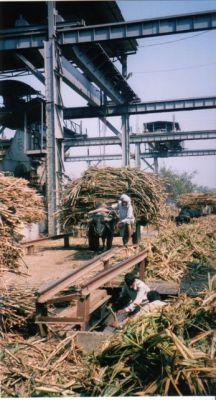
Sugar Mill 5 miles from village

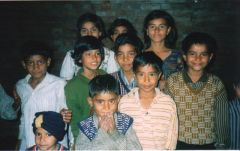
village school boys
village school boys

chopar
chopar

Cinematographer filming village women and Dr. Mahar

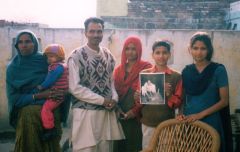
Renu and her family
Renu and her family

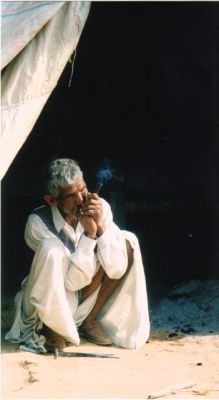
village man smoking chillum

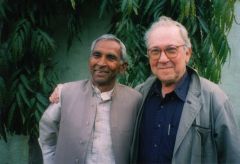
villager Sham Sher on left, Director Robert Richter on right